
Excavating near streams in BC: what applies
Work near a creek, ditch or wetland can bring in the province, the federal government and the city at the same time. Here is how the layers fit.
Water Sustainability Act: changes in and about a stream
Any change in or about a stream needs permission in the form of a legal instrument: an authorized change made by notification, a change approval, an order, or a licence or use approval. The stream channel includes the bed and the banks of the stream.
For listed low-risk changes, a notification must be submitted at least 45 days before work begins, and the work must follow the regulation’s terms and the regional timing windows for instream work.
Timing windows for instream work are set by region.
Riparian Areas Protection Regulation
Where the regulation applies (including the Fraser Valley and Metro Vancouver regional districts, except the City of Vancouver), a local government must not approve residential, commercial or industrial development in the riparian assessment area until it has an assessment report from a Qualified Environmental Professional. The assessment area is a 30 m strip on each side of the stream.
Fisheries Act
Under the federal Fisheries Act, an authorization is required if a project is likely to kill fish or harmfully alter, disrupt or destroy fish habitat.
DFO lists project types and waterbodies where its review is not required, provided the project follows its measures to protect fish and fish habitat.
Municipal streamside rules compared
| Municipality | Rule | Source |
|---|---|---|
| Township of Langley | Setbacks by watercourse class: 30 m (Class A, Fraser River), 20 m (Class B natural), 7.5 m / 6 m (Class A / B roadside); reductions possible in some cases. ALR land excluded. | Township page |
| City of Langley | Building setbacks 30 m (Class A), 15 m (Class B), 5 m (Class C) unless a QEP sets an alternative under RAPR. | Zoning Bylaw 3300 |
| Surrey | Sensitive Ecosystems DP area within 50 m of fish-bearing streams; permit needed before soil disturbance or clearing. | Surrey DP areas |
| Abbotsford | NEDP area: no clearing, regrading or other land disturbance before a permit is issued. Streamside Protection Bylaw 1465-2005 sets protection areas of 5–30 m. | Abbotsford NEDP |
| Maple Ridge | Watercourse Protection DP for any new development within 50 m of a water feature. | Maple Ridge |
| Pitt Meadows | Riparian Areas DP within 30 m of top of bank; development includes soil disturbance. | Pitt Meadows |
| Delta | Streamside DP for work within 30 m of a stream, river, slough, ditch or pond. | Delta |
| Chilliwack | DPA 3 permit before changes near a watercourse, with a QEP’s RAPR report. | Chilliwack |
How PCE fits in
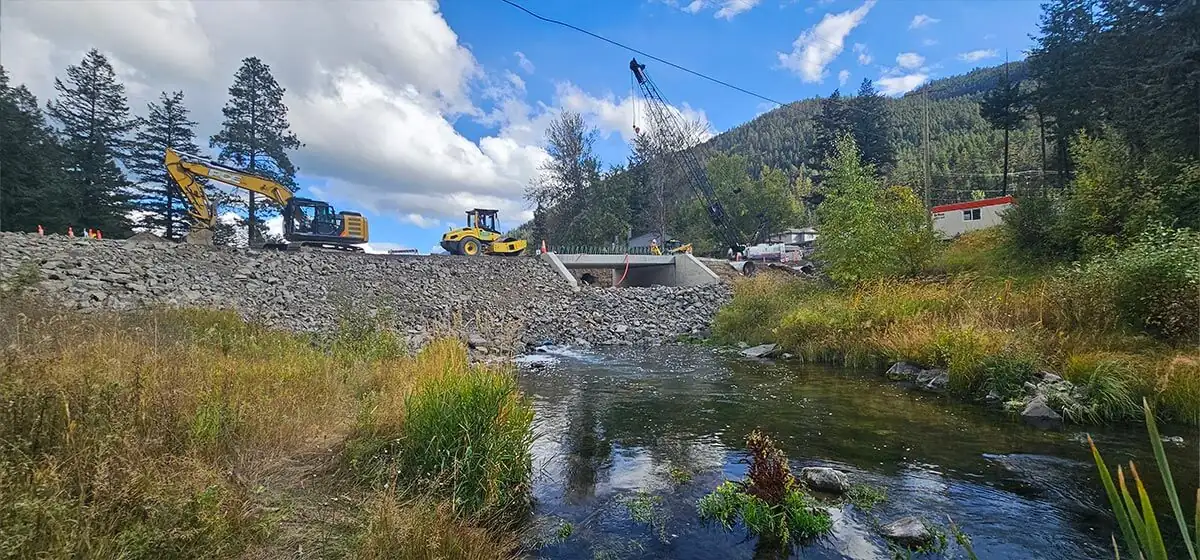
PCE has worked beside live water on environmental and civil projects, including the Paul Lake dam upgrade near Kamloops for Matcon Environmental. On these jobs the environmental consultant and the permits set the rules; the excavation crew’s job is to work within them.
Checked October 2026 against the sources linked on this page. Rules change, so confirm with the authority before work starts. General information only, not engineering or legal advice.
Got a big job coming up?
Tell us where it is, what needs to come out of the ground and when. We’ll tell you how we would do it.