
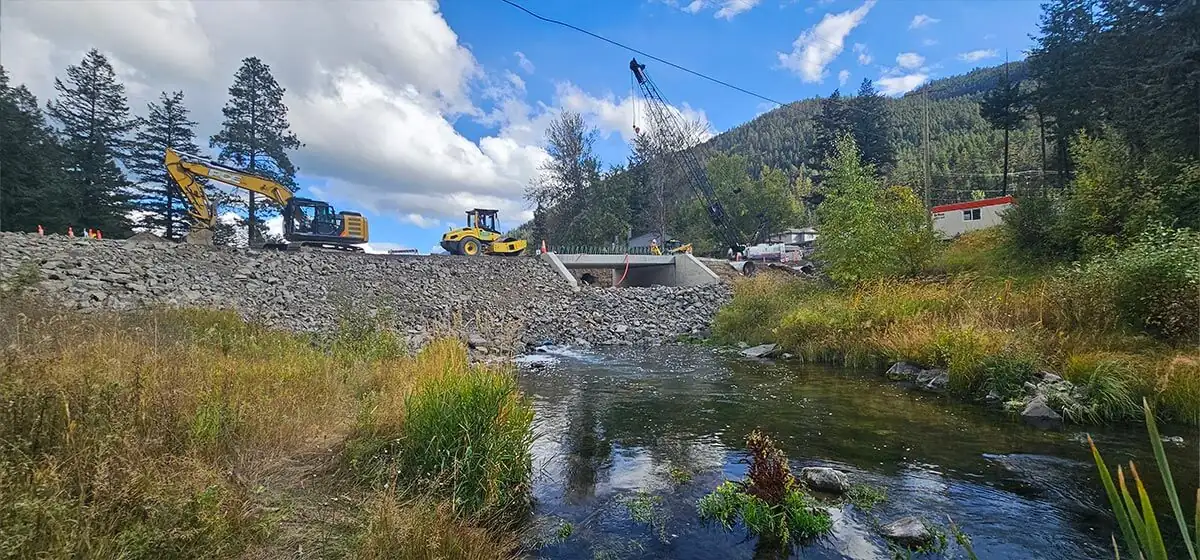
Excavation and earthworks glossary
Terms you will hear on an excavation job, in plain language.
- Backfill
- Material placed back into an excavation around pipes, walls or foundations, usually in compacted layers (lifts).
- Benching
- Cutting the side of an excavation into steps to reduce the risk of collapse.
- Bulk excavation
- Removing the main volume of material from a site, such as the hole for an underground parkade. Also called mass excavation.
- Compaction
- Densifying soil or gravel with rollers or plate compactors so it can carry load without settling.
- Detailed excavation
- Precise excavation for footings, pits, grade beams and services, usually after bulk excavation.
- Geotextile
- Fabric laid under gravel to separate it from soft ground below and stop the two mixing.
- Grubbing
- Removing stumps, roots and buried organic material after trees and brush are cleared.
- Hotshot
- A fast delivery of parts, attachments or small equipment by deck truck.
- Lowbed
- A low trailer used to haul excavators and other heavy equipment.
- Manhole
- A vertical access chamber on a sewer or storm line, usually built from precast concrete sections.
- Riprap
- Large rock placed along banks and shorelines to protect them from erosion.
- Sheet pile
- Interlocking steel sheets driven into the ground to hold back soil or water around an excavation.
- Shoring
- Any system that supports the sides of an excavation, from trench boxes to engineered walls.
- Stripping
- Removing topsoil and organic material before excavation or grading.
- Subgrade
- The prepared native ground that a road, slab or foundation is built on.
- Trench box
- A steel box placed in a trench so people can work inside it, protected from a cave-in.
Last reviewed October 2026. General information only, not engineering or legal advice.
Got a big job coming up?
Tell us where it is, what needs to come out of the ground and when. We’ll tell you how we would do it.